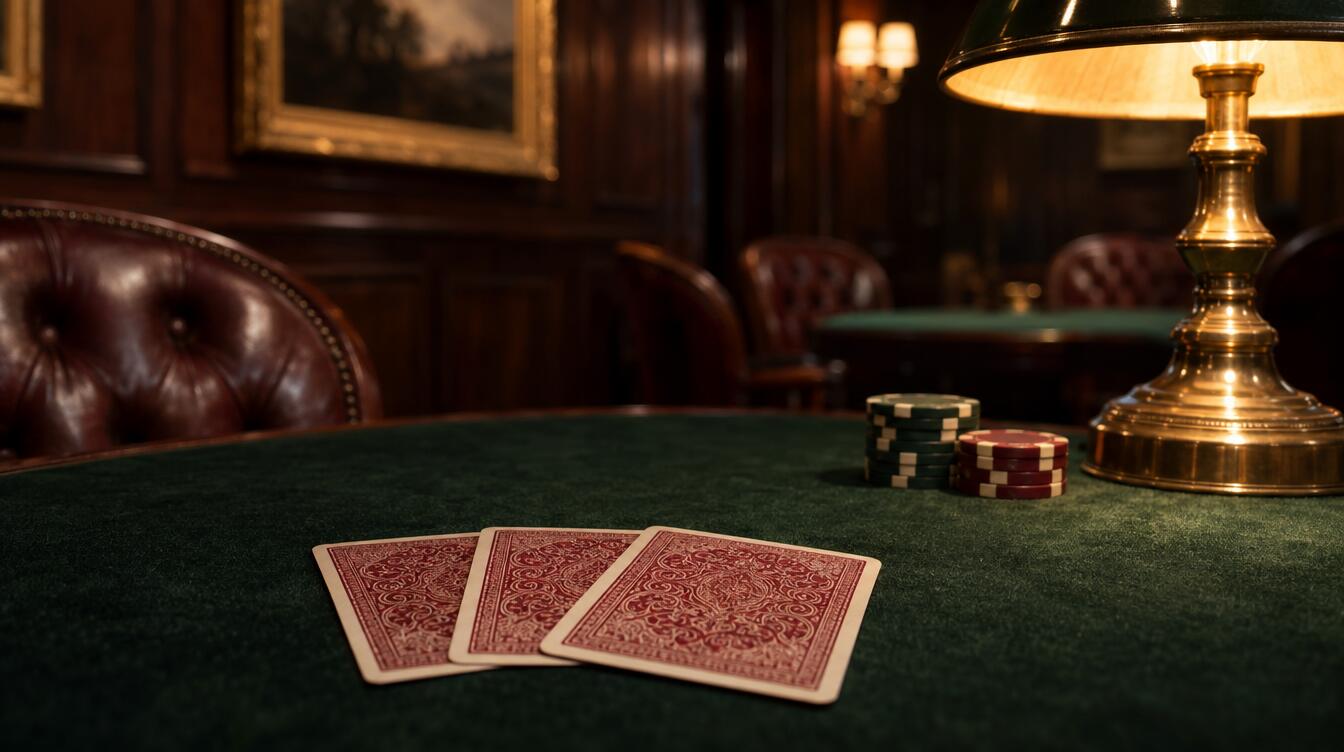
Three card poker was created by Derek Webb, an English poker player. In 1994 he set out to make "a poker game that plays as fast as the other table games". Cutting the hand to three cards and the decisions to one produced a poker game where each hand takes only moments.
Webb patented the game in 1997 and set up his own company, Prime Table Games, to sell it to casinos.
Abroad before home
At the time, British regulations made it hard for casinos to introduce new games, and three card poker struggled to reach tables in its home country. Webb looked abroad, above all to the United States, and won over casinos one by one. Only in 2002 did British rules change to allow the game.
A lawsuit and a sale
In 1999 the company that owned Caribbean stud poker sued three card poker for patent infringement (see Caribbean Stud Tales). As a result Webb sold the rights outside the British Isles to the casino equipment maker Shuffle Master, which took on the defence of the case.
Carried by Shuffle Master's sales network, three card poker spread to casinos around the world and became one of the most popular licensed table games of all. Webb and Shuffle Master later ended up in patent disputes of their own.
Blackjack's 21+3 has the same inventor
The "21+3" side bet seen on many blackjack tables makes a poker hand from your two cards and the dealer's up card. The idea of combining blackjack with a three-card poker bet was patented by Webb as well.
A ranking made for three cards
A straight beats a flush in three-card poker because with three cards, a straight is harder to make. Of the 22,100 ways to pick three cards from 52, straights (not counting straight flushes) account for 720 and flushes for 1,096: the reverse of five-card poker.
Even more curious, a straight flush (48 ways) and three of a kind (52 ways) differ by only four combinations. They are almost equally rare, but the straight flush is just slightly harder to get, so it ranks higher.
Three card poker in numbers
There are 22,100 three-card hands, and about 25.6% of them are a pair or better.
The dealer fails to qualify (below queen high) about 30.4% of the time.
Basic strategy (play Q-6-4 or better) plays about 67% of hands.
Playing Q-6-3 loses about 1.003 antes on average, a difference of only 0.3% from folding.
스리 카드 포커를 고안한 사람은 영국의 포커 플레이어 데릭 웹입니다. 1994년 그가 목표로 한 것은 '다른 테이블 게임만큼 빠른 템포로 즐길 수 있는 포커'였습니다. 카드를 3장으로 줄이고 판단을 한 번으로 하자, 한 게임이 순식간에 끝나는 포커가 탄생했습니다.
웹은 1997년 이 게임의 특허를 받고, 직접 '프라임 테이블 게임스'라는 회사를 세워 카지노에 판매를 시작했습니다.
고국보다 해외에서 먼저
당시 영국에서는 카지노가 새 게임을 들이기에 규제의 벽이 높아, 스리 카드 포커는 좀처럼 고국의 테이블에 오르지 못했습니다. 웹은 미국을 비롯한 해외에서 활로를 찾아 조금씩 채택하는 카지노를 늘려 갔습니다. 영국에서 규제가 바뀌어 스리 카드 포커를 즐길 수 있게 된 것은 2002년의 일이었습니다.
소송이 계기가 된 권리 양도
1999년, 캐리비안 스터드 포커의 권리를 가진 회사가 스리 카드 포커를 특허 침해로 고소했습니다(캐리비안 스터드 이야기). 이를 계기로 웹은 영국 제도 이외 지역의 권리를 카지노 장비 회사 셔플마스터에 넘겼고, 이 회사가 소송을 맡게 되었습니다.
셔플마스터의 판매망을 탄 스리 카드 포커는 전 세계 카지노로 퍼져, 권리를 가진 회사가 제공하는 테이블 게임 가운데 손꼽히는 인기작이 되었습니다. 훗날 웹과 셔플마스터 사이에서도 특허를 둘러싼 다툼이 일어났습니다.
블랙잭의 '21+3'도 같은 고안자
블랙잭 테이블에서 자주 볼 수 있는 사이드 베팅 '21+3'은 자기 패 2장과 딜러의 앞면 1장, 합쳐서 3장으로 포커 족보를 만드는 베팅입니다. 이 '블랙잭과 3장 포커를 조합한다'는 아이디어도 웹이 특허를 받은 것입니다.
3장이기에 생긴 족보 순서
3장 포커에서 스트레이트가 플러시보다 강한 것은 3장에서는 스트레이트가 더 만들기 어렵기 때문입니다. 52장에서 3장을 고르는 22,100가지 중 스트레이트(스트레이트 플러시 제외)는 720가지, 플러시는 1,096가지. 5장 포커와는 반대입니다.
더 재미있는 것은 스트레이트 플러시(48가지)와 트리플(52가지)의 차이가 겨우 4가지라는 점입니다. 거의 같은 정도로 드문 족보지만, 아주 조금 더 나오기 어려운 스트레이트 플러시가 위의 족보로 되어 있습니다.
숫자로 보는 스리 카드 포커
3장의 조합은 22,100가지. 원페어 이상의 족보가 되는 것은 약 25.6%입니다.
딜러가 퀄리파이하지 못할(Q 하이 미만이 될) 확률은 약 30.4%.
기본 전략(Q-6-4 이상이면 플레이)에서는 받은 패의 약 67%에서 플레이합니다.
Q-6-3으로 플레이했을 때의 평균 손실은 앤티의 약 1.003배. 폴드와의 차이는 겨우 0.3% 정도입니다.